Introduction
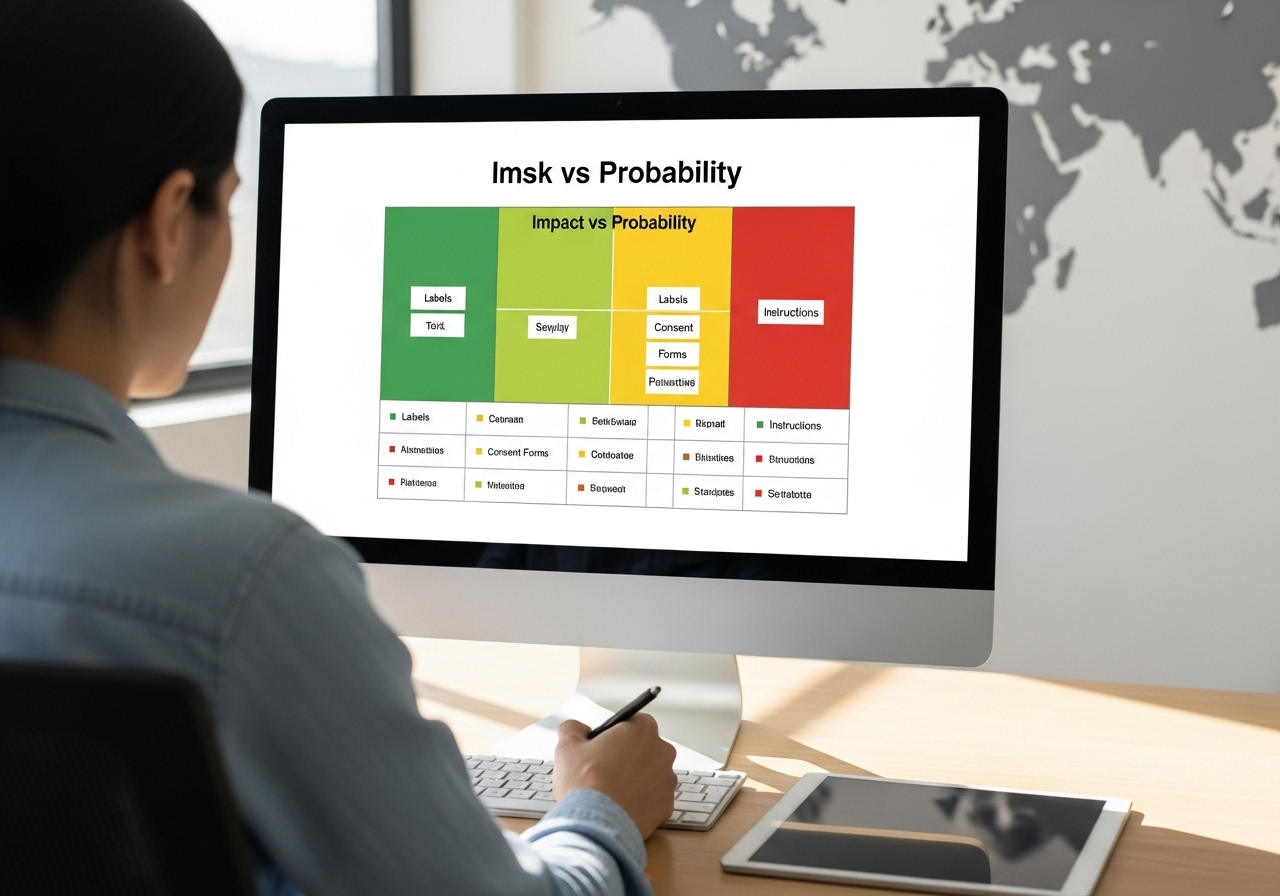
A linguistic risk assessment helps you decide which assets need priority review before a global launch. Using an impact vs probability matrix lets you focus resources where errors would cause the most harm—protecting patient safety, brand reputation and regulatory compliance.
What is the impact vs probability matrix?
The matrix crosses two variables: impact (consequence of an error) and probability (likelihood of occurrence). Each asset is positioned to yield a priority: high, medium or low.
- High impact: errors that affect safety, compliance or correct product use.
- High probability: driven by text complexity, jargon, abbreviations or MT usage.
Steps to run the linguistic assessment
- Inventory assets: list all launch materials (labels, consent forms, app text, technical datasheets, marketing).
- Identify critical segments: safety marks, doses, warnings, instructions.
- Assign impact: label each segment as critical, relevant or minor.
- Estimate probability: based on complexity, abbreviations, MT reliance or past issues.
- Place on the matrix: cross impact and probability.
- Define actions by quadrant: e.g., urgent SME review for high/high; standard review for medium cases; sampling for low/low.
- Allocate resources: assign translators, clinical reviewers and SLAs by priority.
Practical example (brief)
- Drug label (dosage): high impact / medium probability → high priority (clinical review + QA).
- General marketing copy: low impact / low probability → low priority (sampling).
- Informed consent: high impact / high probability → critical priority (specialized translation + local validation).
KPIs and tracking
- % of high-priority segments reviewed pre-launch.
- Average correction time per prioritized segment.
- Number of issues found post-launch.
- Reduction in post-launch clarification queries.
Tools and best practices
- Use a spreadsheet or dashboard to visualize the matrix and assignments.
- Maintain a central glossary and synchronized TM.
- Document decisions and rationale for traceability.
- Run a pilot review in one or two countries before full rollout.
Quick checklist (pre-launch)
- ✅ Complete asset inventory
- ✅ Critical segments identified
- ✅ Impact vs probability matrix filled
- ✅ Action plan and resources assigned
- ✅ Glossary and TM updated
- ✅ Pilot review completed
Conclusion
A linguistic risk assessment gives you control before global launches: prioritize what matters and reduce costly mistakes. At SumaLatam we design assessment matrices, prioritize assets and execute critical reviews ahead of launch. Contact us for a diagnostic and a pilot for your rollout.