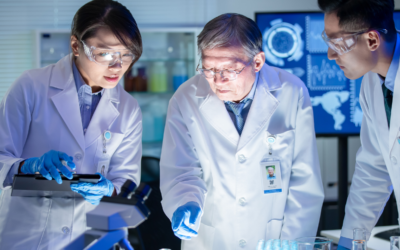
Generative artificial intelligence (AI) is not only transforming traditional sectors like medical education at prestigious institutions such as Harvard Medical School (HMS) but also redefining how we create, translate, and localize digital content worldwide.
In medicine, Harvard Medical School (HMS) has integrated AI into its curriculum, teaching future doctors to use advanced tools to improve diagnoses and optimize patient interaction. This technology, while powerful, presents challenges: how can we ensure data is reliable and ethical? How do we balance reliance on AI with fundamental human skills such as critical reasoning?
At SumaLatam, we understand this technological evolution and apply it to our mission to communicate with people beyond languages, conveying cultures, ideas, products, and services. Our innovation hub, SUMALAB, stays at the forefront of technologies like AI to transform content translation and localization. Just as Harvard Medical School (HMS) uses “tutorbots” trained with proprietary data, at SUMALAB we deploy AI models specifically designed to understand and process linguistic nuances in multilingual and multimedia projects. This ensures that our clients receive solutions that are not only technically flawless but culturally relevant.
For example, similar to how Harvard Medical School (HMS) personalizes education through AI, at SUMALAB we leverage AI to analyze contexts, cultural subtleties, and audience preferences, delivering more accurate translations and localized content that resonates authentically.
The key to this technological revolution, whether in medicine or content creation, is its ability to free up time and human resources, allowing talent to focus on what truly matters: human connection. In medicine, this means more time at the patient’s bedside; in content, it means delivering stories that truly connect.
AI is not just the future of medicine—it’s the present of global communication. At SumaLatam, we are ready to lead this change. If you’re looking for innovative solutions for your translation, localization, or content creation needs, we invite you to discover how SUMALAB can elevate your projects to the next level. Because staying ahead is not just an option—it’s our mission